All the Lovers in the Night (Sode Yukiko, 2026)

This review appeared in somewhat different form as part of the Cannes coverage at InReview Online.
Sode Yukiko’s slice-of-life epic clocks in at just under two and a half hours, but feels more alive than that daunting runtime may suggest. Centered on an extremely shy woman who works as a freelance proofreader, Sode patiently establishes her routine before subtly breaking it up over a period of several months. The result is a solid if not quite audacious entry in the burgeoning subgenre of films about lonely Japanese women opening up to the outside world, familiar in recent years from directors like Iwai Shunji (A Bride for Rip van Winkle) and Ohku Akiko (Hold Me Back). As in the latter’s My Sweet Grappa Remedies, Sode’s heroine finds the courage to open up to the world in that great social lubricant alcohol, and it leads to her meet-cute with an older man, opening the possibilities of friendship, and maybe even romance.
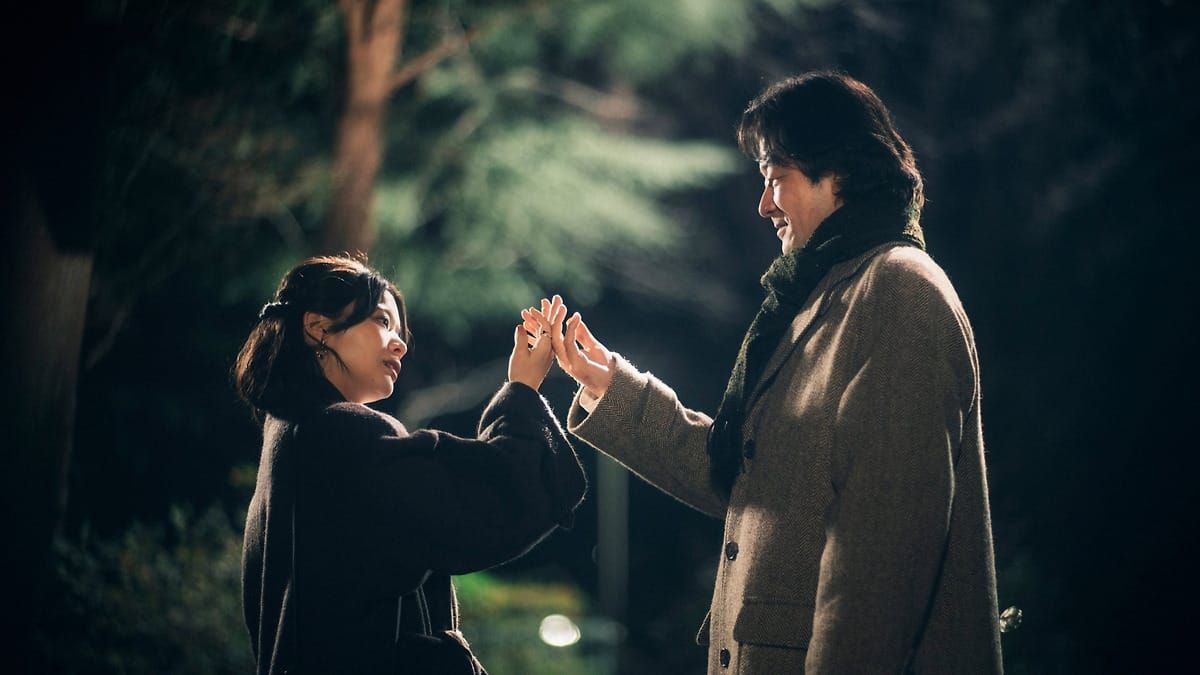
Kishii Yukino plays Fuyoko, the proofreader, and the man she bumps into just before vomiting after day-drinking an excessive amount of sake from a thermos at a community center is none other than Asano Tadanobu. He plays Mitsutsuka, a kindly and quiet middle-aged man, and the two eventually establish a routine where they meet for coffee and discuss the physics of light. She’s interested in but knows nothing about the subject, he’s a high school physics teacher. Fuyoko’s only other regular social interactions are with her sort-of agent, a former co-worker who sends her proofreading jobs named Hijiri, an extrovert with a reputation for promiscuity whose seeming freedom masks an underlying hostility and deep unhappiness—a cautionary tale for our anxiety-ridden heroine as she ventures out into the world. In warm, lovely images, Sode patiently builds Fuyoko’s world: her home office in her tasteful, book-lined studio apartment, her phone calls and occasional outings with Hijiri, her coffee dates with Mitsusuka, her quiet nights thinking over the nature of light.
All the Lovers in the Night builds slowly, like all slice-of-life stories it is about the accumulation of details more than the progression of incident, but it is never boring, establishing a quiet momentum that culminates, as it must, in breakdowns and revelations, but even these are underplayed, detached and curious, like Fuyoko herself. One flashback sequence a third of the way into the film breaks the rhythm and seems designed to give some motivation for Fuyoko’s shyness, and as such is misjudged and unnecessary. Sode’s characters and her actors’ performances are real enough without an inciting incident, and providing one only limits Fuyoko’s world, whereas every other action and image in the film is built around expanding it. But despite that, All the Lovers in the Night remains a quiet gem, a lovely and resonant work of cozy alienation.